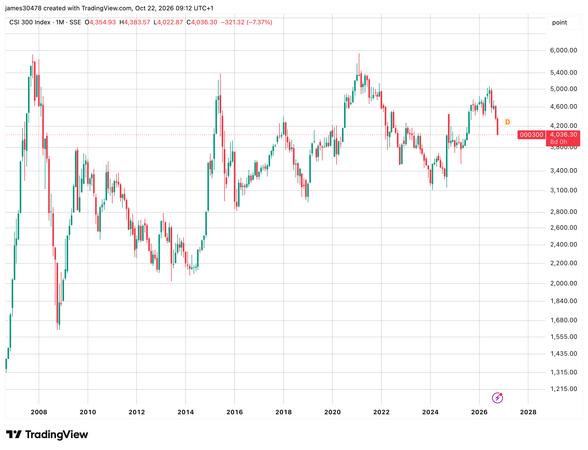
Bitcoin and Asian equity markets faced renewed pressure on Thursday as China's stock market officially entered bear territory, sending ripples across regional exchanges. The cryptocurrency, often viewed as a hedge against traditional market volatility, failed to escape the broader risk-off sentiment that has gripped investors amid concerns over China's economic slowdown.
Bitcoin experienced a notable retreat on Thursday, October 22, 2026, as Asian equity markets tumbled following China's descent into an official bear market—a decline of 20% or more from recent peaks. The world's largest cryptocurrency by market capitalization fell alongside regional stocks, challenging the narrative that digital assets can serve as a safe haven during periods of traditional market stress.
The Chinese stock market's downturn has been fueled by persistent concerns over the country's economic growth trajectory, ongoing property sector challenges, and regulatory uncertainties that continue to weigh on investor confidence. As China represents one of the world's largest economies and a significant player in global trade, its market struggles have historically triggered contagion effects across Asia-Pacific markets.
Bitcoin's correlation with traditional risk assets has become increasingly apparent during this selloff. Despite cryptocurrency advocates positioning digital assets as uncorrelated to legacy financial markets, periods of heightened uncertainty often see investors liquidating positions across all asset classes to raise cash or reduce overall portfolio risk. This phenomenon, known as a "risk-off" environment, tends to impact cryptocurrencies just as severely as equities.
Major Asian stock indices, including those in Hong Kong, South Korea, and Japan, posted significant losses as the session progressed. The synchronized decline underscores the interconnected nature of modern financial markets, where distress in one major economy can rapidly spread to others through trade linkages, supply chain dependencies, and investor sentiment.
Cryptocurrency market analysts are now closely monitoring key support levels for Bitcoin, with some suggesting that sustained weakness in Asian markets could trigger further downside pressure. However, others note that prolonged economic uncertainty in traditional markets could eventually drive renewed interest in decentralized assets as investors seek alternatives to government-backed currencies and traditional financial instruments.
The coming sessions will be critical in determining whether Bitcoin can decouple from broader market weakness or if the cryptocurrency will continue to trade in lockstep with risk assets. For now, the digital asset's behavior suggests that maturation and institutional adoption have made it more, not less, correlated with traditional financial markets during periods of systemic stress.